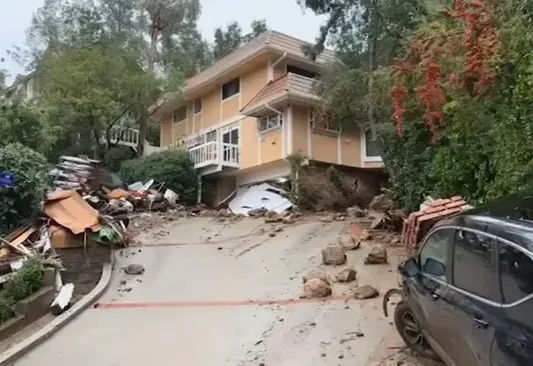
When Crooked Creek overflows in heavy rain, the water that reaches a house is not clean rain water. It carries silt, debris and bacteria from the ground it crossed, and that changes how the cleanup is done.
Key takeaways
- Crooked Creek overflows into low lying areas during heavy rain, and the water can follow the lowest ground into a garage or lower level.
- Creek water is handled as contaminated, so soaked carpet, pad and drywall are usually removed instead of dried in place.
- Standing water and mud come out first, then walls and floors are opened and dried to moisture readings.
- A standard homeowner's policy excludes flood, and a new flood policy has a 30 day waiting period.
- Photograph every room before anything is moved, and keep a list of what was discarded.
Why creek water ends up inside a house
Most tributaries and streams in the city drain to the Chattahoochee River, which forms the northern and western border. Flood damage happens when those streams are inhibited and the water cannot reach the river.
Crooked Creek is one of the creeks that overflows into low lying areas during heavy rain. Once the water is out of its banks, it follows the lowest ground toward the nearest opening in a building.
The water does not need to be deep to cause trouble. A few inches across a garage or a basement floor is enough to soak carpet, cabinets and the bottom of every wall.
After the creek drops, the ground around a house stays saturated for a while. Water can keep seeping through low openings even when the sky has cleared.
- Garage door seams and door thresholds that sit close to the ground
- Window wells and windows on a lower level
- Floor drains and the joint where a wall meets a slab
- Crawl space vents and access doors, for homes that have them
Why creek water is not treated like a pipe leak
A split supply pipe releases clean water. Creek water is different, because it carries mud, bacteria and whatever else the creek picked up on its way.
Restoration standards class this kind of water as Category 3, the most contaminated level. The cleanup follows that class from the first step.
In practice, porous materials soaked by creek water are usually removed and not dried in place. Hard surfaces are cleaned and disinfected, then dried.
- Carpet and pad that touched the water: removed and discarded
- Insulation and drywall that wicked the water upward: cut out
- Concrete, tile and sealed hard surfaces: cleaned, disinfected and dried
- Solid framing: cleaned, then dried until readings return to normal
What the extraction crew does first
The order of work matters, because the longer water sits, the farther it moves into the structure. Each stage builds on the one before it.
Getting the water and mud out
Pumps and wet vacuums pull standing water off the floor. Mud is lifted out by hand and by vacuum so it does not dry into the flooring.
Truck mounted units handle large volumes, and portable units reach closets, stairwells and tight corners. Fast water extraction keeps the water from wicking up into walls and cabinets.
Opening wet walls and floors
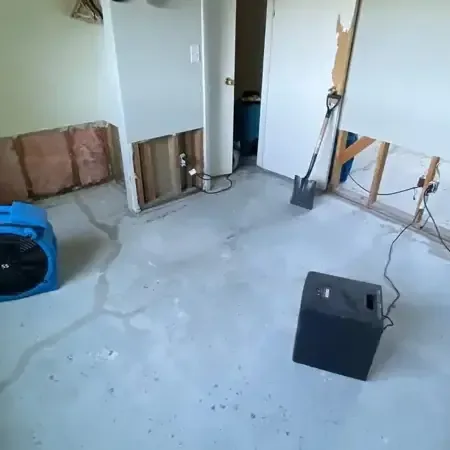
Baseboards come off, and drywall is cut back above the waterline so the wall cavity can dry. Moisture meters show how high the wet zone reaches, and that sets how much material is removed.
Drying to readings
Air movers and dehumidifiers run until moisture readings match a dry reference, not until a calendar date. A rough range for this stage is on the drying time estimator.
- Readings are logged on every visit
- Equipment is moved as each area dries
- Materials are released only when the readings hold
Safety steps before any cleanup begins
Creek water and electricity are a dangerous mix, and standing water can hide a live outlet or a cord on the floor. The household should stay out of flooded rooms until the power to them is off.
If the breaker panel sits in a wet area, an electrician should handle the shutoff. A furnace, water heater or other appliance that sat in the water should be checked before it is restarted.
- Keep children and pets out of the water and the mud
- Wear waterproof boots and gloves, because the water can carry bacteria
- Throw away food, drinks and medicine that touched the water
- Do not use a household vacuum on wet floors
Documenting the loss before anything is moved
Insurers and flood programs ask for proof of what the water reached. Photographs taken before cleanup begin are the strongest record.
Wide shots show the room. Close shots show the waterline on walls and furniture.
- Photograph every wet room from two corners before anything is moved
- Photograph the waterline against a tape measure or a ruler
- List each discarded item with its approximate age and cost
- Keep the moisture readings and equipment logs the restoration team provides
FEMA zones and the flood policy question
The most common FEMA flood zones in Peachtree Corners are zone AE and zone X, including areas FEMA maps as zone AE. The city takes part in the National Flood Insurance Program.
A standard homeowner's policy excludes flood damage. A separate flood policy is needed, and a new one carries a 30 day waiting period before it starts.
That waiting period is why the paperwork question comes before the next storm, not after it. The storm and creek flood cleanup work itself looks the same whatever the policy says.
Getting ready before the next heavy rain
A few steps taken ahead of time cut the damage when Crooked Creek rises. None of them need tools or a contractor.
A finished lower level has the most to lose, and basement flooding cleanup is a common part of a creek loss. A storm warning is the signal to start, and the same checklist can be reused every season.
- Move boxes, electronics and keepsakes off the floor and onto shelves
- Clear leaves and debris from drains and gutters near the house
- Find the main water valve and the breaker panel, and show everyone in the house
- Check that a sump pump or other drainage, where installed, is working
Questions
Does a homeowner's policy cover Crooked Creek flooding?
A standard homeowner's policy excludes flood. Flood coverage comes from a separate policy, such as one written through the National Flood Insurance Program, and a new policy has a 30 day waiting period.
Can creek flood water be cleaned up without help?
A thin film on a hard floor can be handled with gloves and a disinfectant. Soaked carpet, pad and drywall, or any water that reached an outlet, call for trained crews, because the contamination goes deeper than the surface.
How long does a house take to dry after a creek overflow?
Drying runs until moisture readings match a dry reference, and the time depends on how much water entered and how long it sat. Mold can start to grow in 24 to 48 hours, so removal and drying begin as soon as it is safe.
Can wet carpet be saved after creek water?
Carpet and pad that touched creek water are usually discarded, since the contamination cannot be fully removed from the fibers. Area rugs are sometimes cleaned off site, depending on the material.
What does Zone AE mean on a flood map?
Zone AE is one of the zone letters FEMA prints on its flood maps. Zone AE and zone X are the most common in Peachtree Corners, and the zone for a specific address can be found by checking the map.