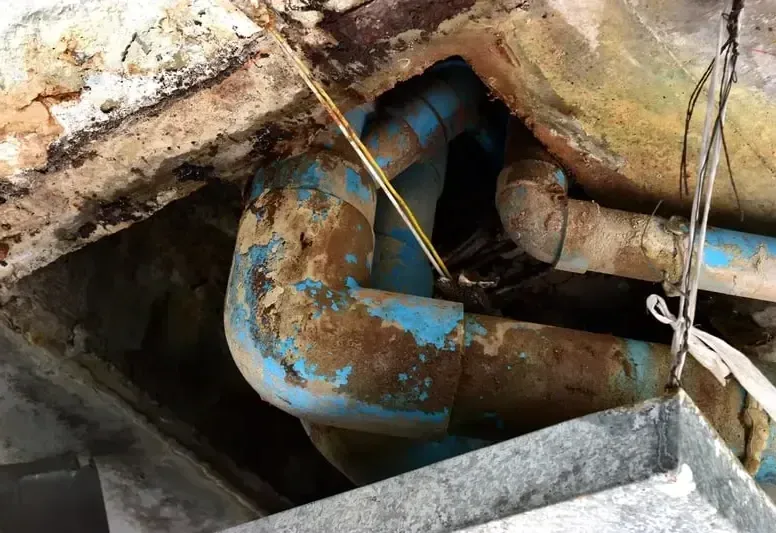
Peachtree Corners grew out of the planned neighborhoods of the 1970s, when Jim Cowart developed Peachtree Station, Chattahoochee Station and Spalding Corners. Homes from that era can hold plumbing with a known weak point, and one common example is gray polybutylene supply pipe.
Key takeaways
- The city grew out of the planned neighborhoods of the 1970s, so some homes are old enough to have original supply plumbing.
- Gray polybutylene supply pipe was common in homes built from the late 1970s into the 1990s and tends to fail at fittings.
- A failed fitting often shows up as a stained ceiling, a soft wall base or a water meter that keeps moving with every fixture off.
- Shut the main valve first, then bring in extraction and drying. The pipe repair itself is a plumber's job.
- A home's age alone does not prove it has this pipe. Only a plumber's inspection can confirm it.
Where the 1970s neighborhoods fit
Jim Cowart developed Peachtree Station, Chattahoochee Station and Spalding Corners in the 1970s. The city itself came later, when voters approved cityhood in November 2011 and municipal operations began on July 1 of the following year.
Any home built in that first wave is now decades old. Decades of use are what put supply plumbing under the microscope.
Homes built together in one period often share the same plumbing parts. That is why one pipe failure on a street can be a useful warning for the rest.
Today the city counts 17,294 households, and plumbing age is one of the quiet variables behind every burst pipe loss.
What gray polybutylene supply pipe is
Polybutylene is a gray plastic supply pipe that went into many homes built from the late 1970s into the 1990s. Its trouble spot is the fittings, the points where the pipe meets a connector.
When a fitting gives way, it can release water steadily inside a wall or above a ceiling. Because the pipe is hidden, the first sign is usually damage and not a drip.
Age alone does not prove a house has it. Some homes of that age have been repiped over the years, and only an inspection settles the question.
- Gray flexible pipe where plumbing is exposed, such as a utility room, under a sink or in an unfinished area
- Fittings that show crusting, staining or a damp film
- A plumber's inspection as the only reliable confirmation
How a fitting failure shows up
A fitting leak is rarely dramatic at first. Water spreads through insulation and drywall long before anyone sees it.
Signs in ceilings and walls
A brown ring that grows after each use of an upstairs bath is a classic sign. A wall that feels cool or soft near the floor points the same way.
- A ceiling stain that spreads or darkens over several days
- Paint that bubbles or peels on an interior wall
- A baseboard that swells or lifts from the wall
- A musty smell with no visible source
Signs at the meter and the fixtures
The water meter is the simplest test. If the dial keeps moving while every fixture and appliance is off, water is escaping somewhere.
- A faint sound of running water in a quiet house
- A water bill that climbs with no change in use
First steps when a fitting lets go
The first minutes decide how far the water spreads. Closing the main valve stops new water, and the rest of the work is containing what already escaped.
A broken fitting is part of burst pipe water damage response, and extraction should not wait for the plumber.
- Shut the main valve and open a faucet at the lowest level to drain the pipes
- Turn off power to wet areas if the breaker panel is dry and reachable
- Photograph the stain, the wall and any exposed pipe before anything is moved
- Lift or move furniture and rugs away from the wet area
- Bring in extraction and drying before the plumber starts cutting
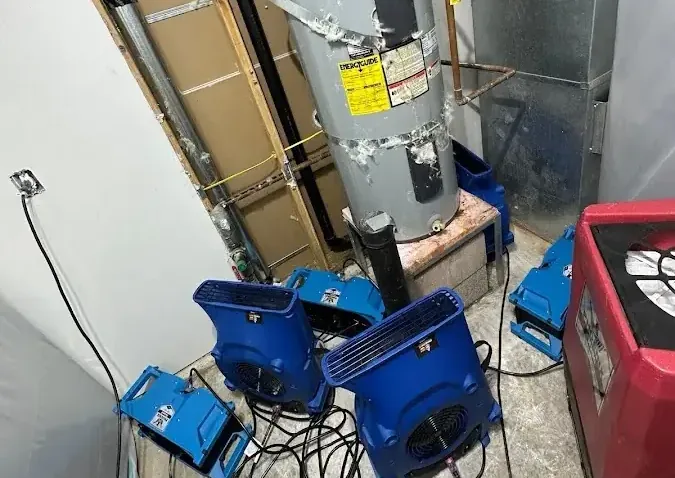
What the drying team does inside the wall
The first job is tracing. Moisture meters and a thermal camera map where the water went, which is often farther than the visible stain.
Wet drywall and insulation come out. Studs and subfloor go through structural drying with air movers and dehumidifiers, and readings are logged until the framing reads dry.
When water reached the room below, ceiling leak water damage work is added to the plan. Drywall above is opened so the joist bay can dry from the top.
The plumber and the drying team often work in sequence. The plumber fixes the pipe, and the drying team makes sure the wall that was wet for days is dry before it is closed.
- Wet insulation and drywall are removed, not dried in place
- Studs, joists and subfloor are dried to a reference reading
- Cabinets and baseboards are pulled so the wall cavity can air out
Why a slow fitting leak gets expensive
A steady leak behind a wall can run for days or weeks before it shows. By then drywall, insulation and the bottom of the framing can be saturated.
Wet materials left in place can also start to grow mold within 24 to 48 hours of becoming damp. That is one more reason to open the wall and dry it early instead of waiting for the stain to fade.
- Insulation holds water and stays wet for a long time
- Drywall paper softens and crumbles once it has been wet for days
- Flooring above or below can cup, lift or stain before the source is found
Getting ready with an older plumbing system
Whether to repipe is a plumber's call and a budget call. The risk can be lowered with a little attention, and the pipe leak risk check is a quick way to size it up.
Many insurance policies treat a sudden pipe failure differently from slow seepage over time. Reading the wording before a loss is easier than reading it during one.
- Locate the main shutoff and test that it turns
- Look at exposed pipe and fittings a couple of times a year
- Photograph the water heater area and utility room as a baseline
- Keep a plumber's name and the policy number somewhere easy to find
Questions
How can a homeowner tell whether a house has polybutylene pipe?
Gray flexible pipe in a utility room, under a sink or in an unfinished area is a clue, but only a plumber's inspection confirms it. Age alone is not proof either way.
Does every home built in the 1970s have this pipe?
No. It was common in homes built from the late 1970s into the 1990s, but some homes have been repiped and others never had it.
Who repairs the pipe after a leak?
A plumber repairs or replaces the pipe. The restoration team removes the water, opens the wall or ceiling and dries the structure.
Can a hidden fitting leak show up without a stain?
Yes. A meter that keeps moving with everything off, a musty smell or a soft baseboard can be the only clues before a stain appears.
Will insurance cover water from a failed fitting?
It depends on the policy and the cause. Many policies cover sudden pipe failures differently from slow seepage, so read the wording or ask the insurer.